


Special Detoxification Method to Support Cancer Patients — Family & Society Magazine
A health recovery journey through the lens of mind–body wellness.
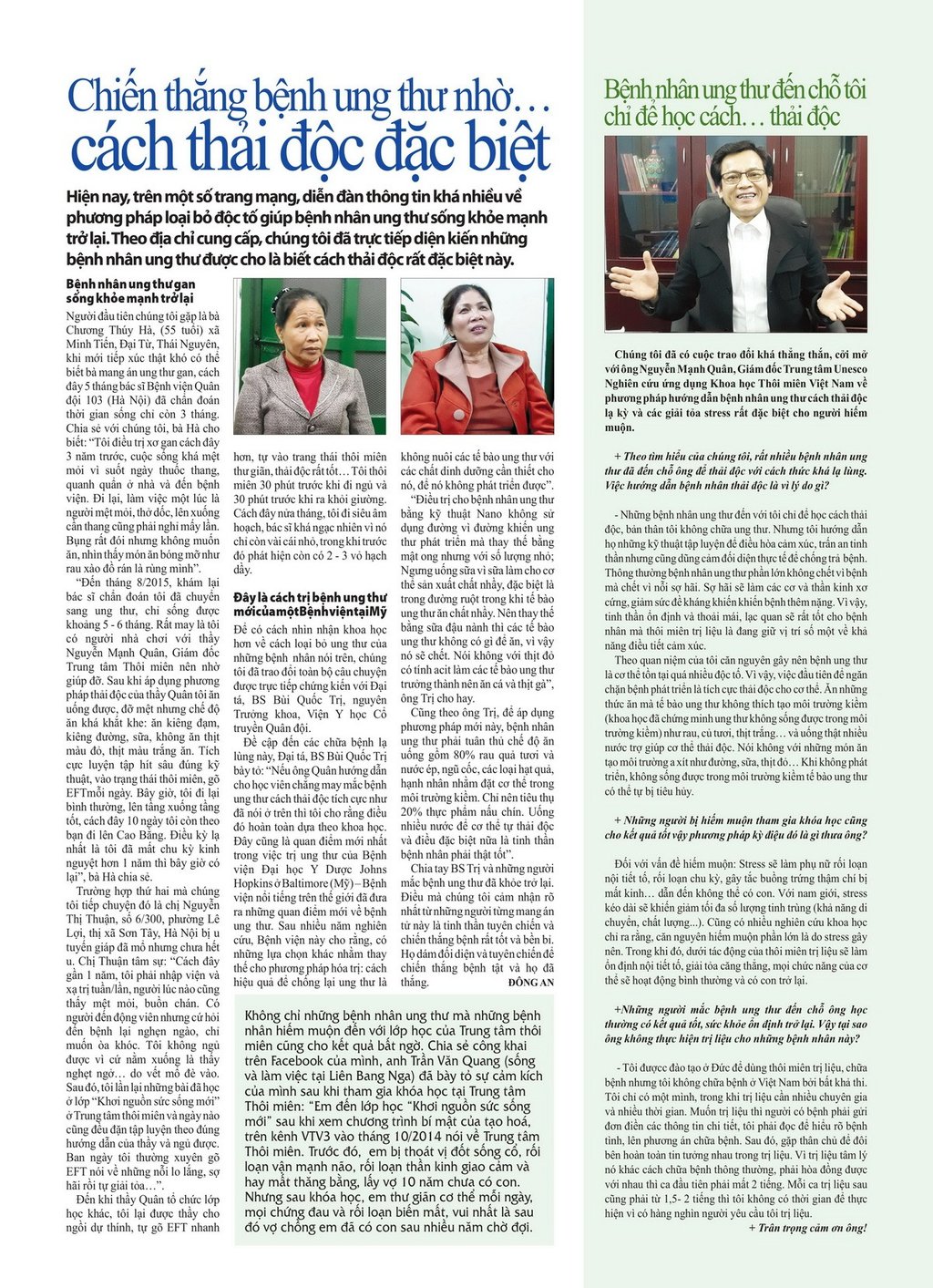
An article in Gia đình & Xã hội (Family & Society) newspaper – Special Lunar New Year 2016 issue (Year of the Monkey) documented several cases of cancer patients and thyroid conditions who applied comprehensive health support methods, including nutritional adjustment, breathing exercises, deep relaxation, hypnotherapy, and EFT. The article focused on the stories of Ms. Chuong Thuy Ha from Dai Tu, Thai Nguyen, and Ms. Nguyen Thi Thuan from Son Tay, Hanoi, along with an interview with Expert Nguyen Manh Quan discussing the role of "detoxification," mental stabilization, and mind-body regulation in supporting patients.
The case of Ms. Chuong Thuy Ha
According to the article, Ms. Chuong Thuy Ha had been treated for liver cirrhosis for many years, experiencing frequent fatigue, shortness of breath with movement, poor appetite, and limited daily functioning. In August 2015, she was diagnosed with liver cancer. Subsequently, she was guided to follow a support program including dietary adjustments, breathing exercises, entering hypnotic relaxation states, and daily EFT practice. She shared that after a period of application, her ability to eat, walk, and perform daily activities improved significantly.
From a scientific perspective, these changes can be understood as improvements in quality of life. In cancer patients, nutrition, sleep, appropriate physical activity, mental state, and stress management can all affect overall health, adaptability, and fatigue levels. However, NCI emphasizes that complementary methods should be used alongside standard medical care when proven safe and appropriate, not as replacements for mainstream cancer treatment. (Cancer.gov) [https://www.cancer.gov/about-cancer/treatment/cam]
The case of Ms. Nguyen Thi Thuan
The article also mentioned Ms. Nguyen Thi Thuan, who had undergone thyroid surgery and continued to monitor remaining nodules. After surgery and radiation therapy, she frequently experienced fatigue, anxiety, depression, and insomnia. When she practiced again the methods learned in the "Igniting a New Vitality" course, she reported improved sleep, more stable emotions, and reduced fear of her illness.
The important point in this case is the role of emotion regulation. When cancer or chronic disease patients live with prolonged anxiety, the nervous system often maintains a state of tension, leading to poorer sleep, more fatigue, and reduced mental resilience. Techniques such as deep relaxation, self-hypnosis, positive visualization, slow breathing, and EFT can help patients reduce stress, sleep better, and become more proactive in their health care process.
How should "detoxification" be understood?
In the article, "detoxification" is used to describe a practice system including balanced eating, adequate water intake, reducing foods that create metabolic burden, increasing vegetables, breathing exercises, relaxation, mental stabilization, and practicing mind-body techniques. A safer scientific understanding is to view "detoxification" not as a single therapy that cures cancer, but as a lifestyle support program aimed at reducing bodily burden and improving quality of life.
NCI notes that no single food, diet, vitamin, mineral, herbal supplement, or combination thereof has been proven to by itself control, cure, or prevent cancer recurrence; patients should discuss any complementary approach with their doctor, as some products or diets may interfere with treatment. (Cancer.gov) [https://www.cancer.gov/about-cancer/treatment/cam]
The role of nutrition and lifestyle
Proper nutrition remains an important foundation in patient care. Cancer patients typically need adequate energy, protein, micronutrients, weight management, and maintenance of muscle mass within their capabilities. The American Cancer Society recommends a healthy lifestyle including balanced eating, prioritizing plant-based foods, maintaining appropriate weight, and regular physical activity within health limits. (Cancer Council) [https://www.cancer.org/cancer/survivorship/healthy-living.html]
For patients with liver cancer, thyroid conditions, or chronic diseases, diet should be individualized based on liver and kidney function, digestive status, weight, ongoing treatments, and physician guidance. Extreme avoidance diets should not be self-imposed, as insufficient energy or protein can lead to wasting, reduced resistance, and impaired tolerance to treatment.
Hypnotherapy, EFT, and stress regulation
In the interview, Expert Nguyen Manh Quan emphasized the role of mental state, fear, and the patient's self-regulation ability. This aligns with the modern mind-body approach. NCI classifies hypnosis, meditation, breathing exercises, yoga, positive visualization, and similar techniques as mind-body therapies, i.e., methods combining mental focus, breathing, and relaxation to support the body and mind. (Cancer.gov) [https://www.cancer.gov/about-cancer/treatment/cam]
NCCIH states that hypnosis has been studied in many contexts such as pain, pre-procedure anxiety, headaches, irritable bowel syndrome, and stress-related issues; the level of evidence varies by condition. (NCCIH) [https://www.nccih.nih.gov/health/hypnosis] In cancer care, mind-body methods may play a supportive role in reducing anxiety, pain, nausea, fatigue, insomnia, and stress, but they do not replace cancer treatment.
Patient proactivity
The notable point in the cases documented in the article is that patients did not merely wait for treatment but actively participated in their own care process. They changed their eating habits, practiced breathing, performed relaxation exercises, faced their fears, and maintained positive beliefs. This proactivity itself can make a significant difference in quality of life.
For those with serious illness, mindset is not a "miracle cure," but it is an important part of recovery. When patients become less fearful, sleep better, eat better, move more, and feel they can do something for themselves, their bodies are generally in a better condition to tolerate treatment and maintain health.
Medical note
The cases in this article are personal reflections and journalistic materials, not clinical evidence to confirm that any method can cure cancer for everyone. Cancer patients should be monitored by oncology specialists and should not stop medication, abandon treatment protocols, discontinue chemotherapy, radiation, surgery, or targeted therapy without professional indication.
Methods such as nutritional support, deep relaxation, hypnotherapy, EFT, breathing exercises, and emotion regulation should be viewed as complementary approaches aimed at improving quality of life, reducing stress, and supporting overall health. Before applying any such method, patients should discuss it with their treating physician to avoid drug interactions, malnutrition, excessive avoidance diets, or delay of necessary treatment.
Source: Gia đình & Xã hội (Family & Society) newspaper – Special Lunar New Year 2016 issue (Year of the Monkey)
References
- National Cancer Institute (NCI). Complementary and Alternative Medicine. https://www.cancer.gov/about-cancer/treatment/cam
- National Center for Complementary and Integrative Health (NCCIH). Hypnosis. https://www.nccih.nih.gov/health/hypnosis
- American Cancer Society. Healthy Living After Cancer. https://www.cancer.org/cancer/survivorship/healthy-living.html
- National Cancer Institute. Nutrition in Cancer Care. https://www.cancer.gov/about-cancer/treatment/side-effects/appetite-loss/nutrition-pdq
Course information
Related course: Haruva – Igniting a New Vitality
Orientation: Self-hypnosis, EFT, deep relaxation, stress reduction, emotion stabilization, healthy lifestyle support, mind-body health
Instructor: Hypnosis Expert Nguyen Manh Quan
Hotline: 0904.606.965
Under the Vietnam Federation of UNESCO Associations, the center trains special methods to improve health, prevent and support treatment of physical and mental issues, and provides training in learning methods, thinking, and applied psychology for communication, business, negotiation, and sales.
© 2026 Trị Bệnh Không Dùng Thuốc. All rights reserved.
Heal your spirit
Contact
Address: Cultural and Sports Center, Yen Phu Ward, No. 1/15, Alley 189 An Duong Street, Tay Ho District, Hanoi.
Hotline: 0904.606.965