



New Life Source Program Participant Has Helped Nearly 50 People with Chronic Conditions
From self-healing to a desire to serve the wider community.
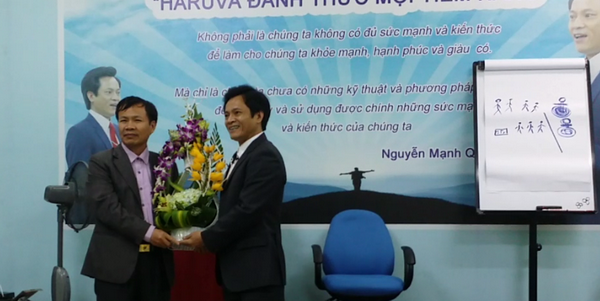
Mr. Nguyen Thanh Nghia, Lieutenant Colonel, Department of Inspection – General Department of Vehicles, was a student of the "Igniting a New Vitality" course. Before attending the course, he suffered from chronic neck-shoulder pain and chronic headaches for a long period. He had tried many different methods, including wax therapy, taking medication, and various conventional pain relief approaches, but the condition only improved temporarily and then recurred.
For him, the pain was not just a symptom. It was a prolonged feeling of heaviness, affecting daily activities, movement, work, and even mental state. Even when riding a motorcycle, his neck-shoulder area and head still hurt, keeping his body in a constant state of discomfort.
After attending the course, especially after the second day when the whole class learned and practiced the EFT method, he shared that the pain sensation had completely disappeared. What surprised him most was that nearly two months after the course ended, the chronic pain had not returned.
Years of chronic neck-shoulder pain and headaches
Chronic neck-shoulder pain and chronic headaches can be related to many factors: muscle tension, posture, stress, insomnia, work pressure, cervical spine degeneration, neck-shoulder movement disorders, anxiety, or other medical causes requiring evaluation.
People who suffer from long-term pain often fall into a very uncomfortable loop: pain causes tension, tension causes muscle contraction, muscle contraction worsens the pain. When this condition persists, the nervous system can become more sensitized, making patients perceive pain more strongly even when the triggering stimulus is not severe.
Before the course, Mr. Nghia had tried many ways to relieve pain but only felt better for a few days. When medications or external supportive methods only provide temporary relief, patients easily feel helpless, not knowing what to do to become more proactive with their own bodies.
EFT – the method that helped Mr. Nghia perceive change right in class
In the "Igniting a New Vitality" course, students are guided in the EFT method – a technique combining naming an issue, focusing on an emotion or uncomfortable sensation in the body, using a setup phrase, and gently tapping on certain points on the body.
After the second day of class, when the whole class practiced EFT, Mr. Nghia clearly felt that his chronic neck-shoulder pain and headaches had disappeared. Even when riding his motorcycle, he no longer felt the pain as before. For him, this was something he had not experienced in a very long time.
This change not only made him happy to feel lighter himself but also made him begin to believe in the practical value of the methods he had learned. When a person personally experiences results, belief no longer comes from recommendations or theory but from their own body.
Nearly two months later, the pain did not return
Mr. Nghia shared that as of nearly two months after the course ended, he could confirm that his chronic pain condition had completely improved and, at the time of sharing, there was absolutely no sign of recurrence.
For someone who had been in pain regularly, having pain not return for many weeks is a very meaningful experience. It shows that the method not only helped him feel lighter in class but also opened up the possibility of long-term self-care if practiced correctly.
Chronic pain often requires a comprehensive approach. Alongside medical evaluation when needed, patients may need to change posture, engage in appropriate movement, get enough sleep, reduce stress, relax, improve lifestyle habits, and learn to calm the nervous system. EFT, self-hypnosis, and deep relaxation can play supportive roles in that process.
From personal experience to a desire to help others
After directly experiencing the results on himself, Mr. Nghia developed a desire to help those around him. At his age, he shared that he no longer felt shy about wanting to help someone. Therefore, whenever he heard that friends, colleagues, or acquaintances were suffering from back pain, shoulder pain, or neck pain, he would try using the methods he had learned to support them.
This shows a special value of the "Igniting a New Vitality" course: students not only learn to improve their own health but can also bring basic, safe, and easy-to-practice techniques home to support family, friends, and loved ones within appropriate limits.
When someone who has experienced pain and then felt relief truly understands the suffering of those in pain, it is that empathy that makes helping others feel natural.
The first case after the course: supporting a 72-year-old with a herniated disc
Immediately after finishing the three days of class, Mr. Nghia and Mr. Quang, a fellow student, went to support a 72-year-old elderly person. The elderly person had suffered from a herniated disc for a long time, with back pain radiating down the leg, to the point of being unable to walk normally.
Mr. Nghia shared that after one supportive therapy session, the elderly person was able to walk again, and from that time until he shared the story, the pain had not returned as before. This first success made Mr. Nghia much more confident in the knowledge, techniques, and practical value of the methods he had learned.
For him, it was not just a successful support case. It was a turning point that made him realize that what he learned in class could be applied to real life, with real people, real pain, and real joy.
Nearly 50 people supported in just over a month
After the first case, Mr. Nghia continued to support friends, colleagues, and acquaintances suffering from chronic pain conditions such as back pain, shoulder pain, neck pain, headaches, leg pain, pain from herniated discs, or other prolonged pain issues.
He shared that in just over a month, he and Mr. Quang had supported nearly 50 people in improving various chronic pain conditions. Among them were even relatives of doctors. For him, this was something that, without witnessing it directly, would be very hard to believe or imagine.
Such stories show that when a method is taught in a practical, easy-to-understand, and easy-to-apply way, and when learners use it with a spirit of goodwill, it can spread into community value.
Why can a student support others?
The core point is not that a student becomes a doctor or medical expert after a short course. The core point is that students learn certain mind-body support tools that can be used in daily life: calming emotions, guiding relaxation, helping others focus on body sensations, reducing stress, using EFT, and creating a greater sense of safety.
Many chronic pain conditions have components related to stress, muscle tension, fear of movement, anxiety, or prolonged nervous system responses. When a person in pain is guided to relax, their emotions calm, their body becomes less tense, and their attention shifts, pain perception in some people can decrease significantly.
However, community support must be performed within safe limits. Students should not diagnose illness, should not tell others to stop taking medication, should not replace doctors, and should not intervene in emergency situations or serious pathologies. The appropriate role is to support relaxation, guide the methods learned, and encourage the patient to seek medical evaluation when there are unusual signs.
"Igniting a New Vitality" – a course that awakens self-care ability
The "Igniting a New Vitality" course is designed to help students better understand the body, emotions, stress, sleep, pain, and the nervous system's ability to self-regulate. In the course, students are guided in methods such as EFT, self-hypnosis, deep relaxation, positive suggestion, emotion recognition, and self-therapy practice within safe limits.
The goal of the course is not to create dependence on a therapist. On the contrary, the goal is to give students tools to care for themselves, to calm their own bodies when stressed, to support themselves when in pain, to stabilize their own emotions, and to know how to maintain a more positive mind-body state.
Mr. Nguyen Thanh Nghia's story shows another layer of value: when a person becomes healthier themselves, they can become a source of support for others. When a person understands a method, they can share it. When a good experience spreads, the community gains more hope and more ways to care for each other.
Excerpt from Mr. Nguyen Thanh Nghia's reflection
"I suffered from chronic neck-shoulder pain and chronic headaches. I tried many methods, including wax therapy, but could not recover completely."
"Usually, if I took medication or did wax therapy, I would only feel better for a few days, then the pain would return."
"When I attended this course, just after the second day of class, when everyone had learned and practiced the EFT method, my pain sensation completely disappeared."
"Even when riding my motorcycle, I no longer felt pain. This was something I had not been able to experience for a very long time."
"As of today, nearly two months after the course ended, I can confirm that my chronic pain condition has completely improved and, up to now, there has been absolutely no sign of recurrence."
"Precisely because I personally experienced and felt the effects and benefits of the therapy and self-therapy methods and techniques I learned in the course, I developed the intention to help people in the community."
"Immediately after finishing the three days of class, Mr. Quang, who had also studied with me in the course, and I went to support a 72-year-old elderly person."
"In just over a month, Mr. Quang and I, the two of us, have supported nearly 50 people in improving various chronic pain conditions."
From technique to a compassionate heart
What is valuable in Mr. Nghia's story is not just the number of people supported. What is valuable is the spirit of compassion. Having experienced pain and personally felt the change, he wanted to bring that to others.
A method truly comes to life when it enters people's daily lives. When it helps someone hurt less. When it helps an elderly person walk more easily. When it helps a friend reduce neck-shoulder pain. When it makes a family happier because a loved one suffers less.
From the classroom, the method goes out into the community. From personal experience, it becomes sharing. From a student, it becomes acts of helping.
Common issues students apply the methods to support
After the course, students typically apply the methods to mind-body issues such as:
- Neck-shoulder pain and tension-related headaches
- Back pain, hip pain, sciatica
- Body aches, joint pain, neck pain
- Insomnia, tension, stress
- Anxiety, fear, negative emotions
- Feelings of fatigue, heaviness, low energy
- Chronic pain conditions that have been examined and need additional support with relaxation, emotions, and self-care
These methods are best understood as supportive tools. For serious pathologies, prolonged pain of unknown cause, post-traumatic pain, numbness or weakness, fever, weight loss, rapidly increasing pain, or unusual symptoms, patients need medical evaluation.
The value of practice after the course
The course is only the beginning. The real value lies in students taking the methods home and practicing them. Mr. Nghia did not stop at "having finished the course." He used the methods on himself, observed the results, and then applied them to support others.
It is the process of practice that makes the techniques come alive. Each time he supports someone, he learns more about the human body, about emotions, about belief, about how a person in pain responds, and about the need for patience.
The more correctly a learner practices, the more they understand safety limits, the more they know when to support and when to advise the patient to see a doctor. That is how mind-body methods can spread responsibly.
Scientific and safety note
The content of this article is the personal reflection of a student and feedback from the process of applying the methods after the course. Results may vary depending on the individual, cause of pain, severity of condition, medical history, responsiveness, stress state, sleep, living environment, and consistency of practice.
Methods such as EFT, self-hypnosis, deep relaxation, positive suggestion, and emotion regulation should be understood as tools to support mind-body health. They do not replace medical examination, diagnosis, medication, physical therapy, surgery, emergency care, or specialized medical treatment when necessary.
Post-course students may support loved ones within the scope of what they have been taught, but should not diagnose illnesses, intervene in serious conditions, tell others to stop medication, or delay medical evaluation. People with severe pain, post-traumatic pain, numbness or weakness in limbs, radiating pain with muscle weakness, bowel or bladder dysfunction, fever, unexplained weight loss, sudden severe headache, chest pain, shortness of breath, or unusual symptoms should seek timely medical evaluation.
Course information
Related course: Haruva – Igniting a New Vitality
Orientation: EFT, self-hypnosis, deep relaxation, pain perception support, stress reduction, emotion stabilization, mind-body health care
Instructor: Hypnosis Expert Nguyen Manh Quan
Suitable for: People wanting to learn self-care methods, reduce stress, support body aches, improve sleep, and know how to support loved ones within safe limits
Hotline: 0904.606.965
Email: chualanhkhongdungthuoc@gmail.com
References
- National Center for Complementary and Integrative Health (NCCIH). Relaxation Techniques: What You Need To Know. https://www.nccih.nih.gov/health/relaxation-techniques-what-you-need-to-know
- National Center for Complementary and Integrative Health (NCCIH). Hypnosis. https://www.nccih.nih.gov/health/hypnosis
- National Heart, Lung, and Blood Institute (NHLBI), NIH. Sleep Deprivation and Deficiency. https://www.nhlbi.nih.gov/health/sleep-deprivation
- Centers for Disease Control and Prevention (CDC). About Sleep. https://www.cdc.gov/sleep/about/index.html
- Mayo Clinic. Chronic pain. https://www.mayoclinic.org/diseases-conditions/chronic-pain/symptoms-causes/syc-20360373
Under the Vietnam Federation of UNESCO Associations, the center trains special methods to improve health, prevent and support treatment of physical and mental issues, and provides training in learning methods, thinking, and applied psychology for communication, business, negotiation, and sales.
© 2026 Trị Bệnh Không Dùng Thuốc. All rights reserved.
Heal your spirit
Contact
Address: Cultural and Sports Center, Yen Phu Ward, No. 1/15, Alley 189 An Duong Street, Tay Ho District, Hanoi.
Hotline: 0904.606.965