



Ending 20 Years of Sciatic Pain Through “Psychological Acupressure” — Featured in Health & Life Magazine
The story of Đặng Văn Khanh and his nearly two-decade journey with sciatic nerve pain.

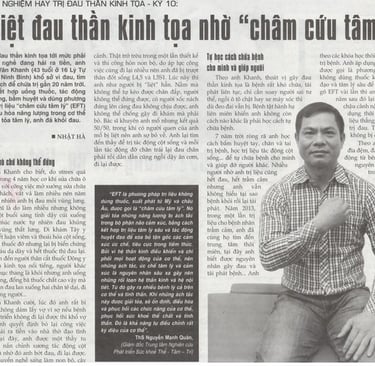
An article by author Nhat Ha, published in Khoa học & Đời sống (Science & Life) newspaper, Issue 43, dated April 8, 2016, documented the case of Mr. Dang Van Khanh, 43 years old, from Ly Tu Trong, Ninh Binh. Mr. Khanh suffered from severe sciatica to the point of having to give up his car repair job that provided a good income, spent nearly 20 years searching for various treatments, and gradually improved thanks to a combination of methods including medication, spinal manipulation, acupressure, and the EFT method, which the article called "psychological acupuncture."
According to Mr. Khanh, the illness began in 1996, after a period of studying auto mechanics under high pressure and working extensively in repair shops. Initially, he only felt back pain and fatigue, thinking it was the result of overwork. But one morning, when bending down to a well to fetch water, he suddenly experienced intense pain in his lower back. When examined by Western medicine, he was diagnosed with spinal inflammation and degeneration. Injections and oral medications provided temporary pain relief, but the pain later recurred, and he also developed complications of stomach bleeding. He then turned to Eastern medicine, taking herbal remedies for many months, but his back pain still radiated down both legs, with numbness, and he had to walk bent over.
The prolonged illness made him pessimistic, to the point of not daring to get married for fear that his worsening condition would burden a wife and children. Later, he went to a church for retreat, where a monk specializing in bone adjustment performed spinal manipulation, which helped reduce his pain and allowed him to walk again. He switched to making miniature landscapes and bonsai, but during one landscaping project, due to work pressure and excessive walking, he suffered slippage of the L4-L5 and L5-S1 vertebrae. This relapse was very severe: he could not pull up his blanket while lying down, could not stand up, if someone lifted him by the armpits to stand, the pain was unbearable, and when he wanted to see a doctor, he could not even use a cane but had to crawl.
Sciatica from the perspective of modern medicine
Sciatica is a condition characterized by pain along the distribution of the sciatic nerve, typically starting in the lower back, radiating through the buttock, down the back of the thigh, the calf, and possibly to the foot. The pain may be accompanied by numbness, tingling, burning, muscle weakness, or an electric shock sensation. Anatomically, the sciatic nerve is formed by the lumbosacral nerve roots, especially L4, L5, S1, S2, and S3. When these nerve roots are irritated, inflamed, or compressed, patients may experience radiating pain of the sciatic type.
Common causes include herniated disc, spinal stenosis, spinal degeneration, spondylolisthesis, deep gluteal muscle spasm, or post-traumatic injury. In Mr. Khanh's case, the article describes multiple factors that may have been involved together: spinal inflammation and degeneration, pain radiating down both legs, L4-L5 and L5-S1 spondylolisthesis, heavy labor, prolonged stress, and relapses after improper or excessive movement.
An important point is that sciatica is not just a matter of "bone pressing on nerve." With pain persisting for many years, the nervous system can become more sensitized. In that state, a small stimulus such as sitting in a cramped car, riding a bumpy motorcycle, lifting heavy objects, twisting incorrectly, or prolonged stress can trigger a pain flare-up. This is why many people improve for a while and then relapse, even after medication, spinal manipulation, or acupressure.
Chronic pain as a bio-psycho-social phenomenon
The modern view of chronic pain does not see pain merely as a signal from damaged tissue. Pain is the result of a complex processing system involving peripheral nerves, the spinal cord, the brain, the immune system, the endocrine system, sleep, emotion, pain memory, beliefs about the body, and the living environment. Therefore, two people with identical spinal imaging findings can experience pain very differently; conversely, one person may have structural changes but little pain, while another may have severe pain even when the injury does not fully correspond to the image.
When pain persists, the brain may enter a state of high vigilance. Brain regions involved in attention, emotion, danger prediction, and memory begin to participate more strongly in the pain experience. The patient not only experiences pain because of nerve root irritation but also because the body is constantly in a defensive posture. The back, hip, gluteal, and leg muscles may be chronically contracted. The patient fears bending, twisting, walking, sitting for long periods. This fear of movement itself makes the body stiffer, reduces circulation, decreases flexibility, and makes pain more likely to recur.
Mr. Khanh's case clearly reflects this model. He not only suffered from structural spinal issues but also lived for many years with stress, anxiety, loss of movement freedom, fear of relapse, and had to continuously search for ways to help himself. This is a very typical picture of chronic pain: the disease is no longer located solely in the back but has become a whole-system state of the body-mind.
Stress and mechanisms that worsen pain
Mr. Khanh believed that stress was an important factor in his illness. This observation has a basis in modern pain science. When humans experience prolonged stress, the sympathetic nervous system becomes more active, the hypothalamic-pituitary-adrenal (HPA) axis increases its activation, and cortisol and other stress mediators change. The body shifts into a survival state: muscles tense, breathing shallow, sleep poor, digestion disturbed, pain threshold lowered, and the immune system becomes unbalanced.
In people with spinal pain, stress can increase tension in the back and hip muscles, reduce sleep quality, and cause the brain to predict that the body is "unsafe." When the brain assesses the body as being under threat, pain sensation typically increases to force the patient to pay attention and protect the painful area. This mechanism is useful in acute injury, but if prolonged for months or years, it can become a pathological loop.
Therefore, stress reduction is not a vague recommendation. In chronic pain, stress reduction is part of multimodal treatment. It can reduce neural vigilance, decrease muscle contraction, improve sleep, and help patients return to movement more safely.
EFT – "Psychological acupuncture" – how can it be understood?
The article calls EFT "psychological acupuncture" and describes it as a method combining acupoints and deep psychology to regulate energy and release psychological blocks. In cautious scientific language, the concept of "stagnant energy" is not yet a proven biological mechanism according to standards of empirical medicine. However, EFT can still be analyzed as a mind-body technique comprising multiple components that may affect the nervous system and emotions.
When practicing EFT, patients typically focus on a specific issue, name the uncomfortable sensation, rate the level of pain or emotion, then gently tap rhythmically on certain points of the body while repeating a setup phrase. This process may produce multiple simultaneous effects. The patient does not avoid the pain but observes it in a guided state. Fearful emotions are named. Rhythmic tapping creates repetitive sensory stimulation, which may calm the body. The setup phrase helps restructure how the patient speaks to themselves. The class or therapeutic context creates a feeling of safety. All these factors may reduce the brain's threat response to pain signals.
From a clinical psychology perspective, EFT somewhat resembles controlled exposure. The practitioner engages with the memory, sensation, or fear related to pain but is not swept into panic. From a neuroscience perspective, EFT may shift attention, reduce stress activation, increase feelings of control, and lower the pain intensity predicted by the brain. From a behavioral medicine perspective, EFT may help patients move from a passive position to an active role of self-regulation.
The role of relaxation hypnosis during relapse
The article states that after studying at the Center, Mr. Khanh tapped EFT a few times and his pain disappeared, but about a year later he relapsed after lifting a heavy bonsai pot. At that time, he lay still, used relaxation hypnosis to straighten his spine therapeutically, and tapped EFT for pain. From then until the time of the article, he reported no further pain.
This detail is very important because it shows that improvement is not a one-time magical disappearance. Spinal pain can relapse when the body is overloaded. But if the patient has self-regulation skills, they can intervene earlier in the pain–tension–fear–muscle contraction loop. Relaxation hypnosis helps the body reduce its vigilance response, decrease contraction, focus on images of recovery, and increase feelings of control. When combined with EFT, the patient simultaneously calms emotions, reduces the pain response, and restores belief that the body can stabilize again.
Hypnotherapy in modern medicine is generally understood as a state of deep focus, relaxation, and increased responsiveness to positive suggestions under conditions of voluntary client cooperation. Many studies have examined hypnosis in pain control, pre-procedure anxiety, irritable bowel syndrome, headaches, and stress-related conditions. Effectiveness varies by individual, but common mechanisms involve attention regulation, changing the meaning of pain sensation, reducing stress, and increasing self-control ability.
Why can a psychological method affect physical pain?
The central question of the article is: why can a method working with psychology help sciatica, a problem seemingly related to the spine and nerves?
The answer lies in the nature of pain. Pain is an experience generated by the brain based on information from the body and the overall bodily context. If the brain receives signals from irritated nerve roots but simultaneously the body is relaxed, the patient calm, muscles soft, beliefs more positive, and feelings of safety increased, pain intensity may decrease. Conversely, if the body signals are similar but the patient is sleep-deprived, anxious, fearful of paralysis or surgery, tense, and highly stressed, the brain may amplify the pain.
Therefore, modern chronic pain treatment typically targets not only damaged tissue. It needs to combine appropriate movement, physical therapy, pain education, sleep improvement, stress reduction, adjustment of beliefs about movement, medication when needed, medical intervention when indicated, and mind-body methods that help patients self-regulate. EFT and hypnosis, if used within appropriate scope, can be part of this neuro-psychological regulation support group.
Comments from Master's degree holder Nguyen Manh Quan in the article
According to Master's degree holder Nguyen Manh Quan, EFT is a non-pharmaceutical therapy method originating from the US and Europe, called "psychological acupuncture." He described this method as a combination of deep psychological therapy and acupoint stimulation to release suppressed, negative emotions in the subconscious. According to his explanation, psychological and emotional inhibitions can disturb the nervous and endocrine systems, thereby affecting physical and mental health; when these blockages are released, the body can stabilize and recover its functions better.
This interpretation can be clarified in modern scientific language as follows: prolonged negative emotions and chronic stress can affect the autonomic nervous system, the stress endocrine axis, sleep, inflammatory responses, movement behavior, and pain perception. When patients receive support to reduce stress, process stuck emotions, achieve deep relaxation, and shift their internal sense of safety, the nervous system may become less vigilant, the body less tense, and symptom perception may improve. This understanding is more consistent with scientific standards while still preserving the core spirit of the method: body and mind have a bidirectional relationship.
What this case may suggest
The case of Mr. Dang Van Khanh suggests that chronic sciatica may improve when patients combine multiple approaches: medical treatment when needed, spinal manipulation, acupressure, learning self-care skills, stress reduction, lifestyle adjustments, adequate sleep, proper nutrition, and practicing EFT or relaxation hypnosis. The notable point is not that a single technique "cures" everything, but the integrated model: the body needs care in terms of structure, nerves, emotions, and lifestyle.
This case also shows that chronic patients can become deeply knowledgeable about their own bodies. After many years of pain, Mr. Khanh not only sought treatment for himself but also learned acupressure for hands, feet, and ears, spinal manipulation therapy, and helped others. This reflects an important principle in recovery: the patient is not only a recipient of treatment but can become an active participant in their own healing process.
What should not be over-concluded
From a single article and one individual case, it cannot be concluded that EFT cures herniated discs, spondylolisthesis, or sciatica for everyone. Nor can it be asserted that sciatica always has stress as its primary cause. In many cases, sciatica has a clear mechanical cause requiring diagnostic imaging, medication, physical therapy, pain injections, or surgery when indicated. Certain neurological symptoms are emergencies and should not be delayed.
A safe understanding is: EFT, relaxation hypnosis, and mind-body regulation methods may help some people reduce pain, reduce stress, improve sleep, reduce fear of movement, and increase feelings of control. They should be used as complementary parts of multimodal care, not as replacements for medical examination and treatment.
Medical and safety note
People with sciatica should see a doctor if the pain persists, worsens, radiates down the leg with numbness or weakness, causes difficulty walking, or does not improve after a period of self-care. Emergency care is needed immediately if there is bilateral sciatica, severe leg weakness or numbness, numbness in the genital or anal area, urinary retention, difficulty urinating, loss of bladder or bowel control, as these may be signs of serious nerve compression.
EFT, self-hypnosis, deep relaxation, acupressure, spinal manipulation, and mind-body methods need to be practiced correctly, with appropriate guidance, and should not be used to delay medical treatment when there are dangerous signs. People with spondylolisthesis, severe disc herniation, osteoporosis, spinal injury, cancer, infection, fever, unexplained weight loss, or paralysis need specialist medical evaluation before applying any body-manipulation methods.
Source of original article: Nhat Ha – Khoa học & Đời sống (Science & Life) newspaper, Issue 43, April 8, 2016
Related program: Haruva – Igniting a New Vitality
Methods mentioned: EFT, relaxation self-hypnosis, stress regulation, pain perception support
Hotline: 0904.606.965
Email: chualanhkhongdungthuoc@gmail.com
References
- National Health Service (NHS). Sciatica. https://www.nhs.uk/conditions/sciatica/
- National Center for Complementary and Integrative Health (NCCIH). Hypnosis. https://www.nccih.nih.gov/health/hypnosis
- Verywell Health. What Is Sciatica? https://www.verywellhealth.com/sciatica-7500866
Under the Vietnam Federation of UNESCO Associations, the center trains special methods to improve health, prevent and support treatment of physical and mental issues, and provides training in learning methods, thinking, and applied psychology for communication, business, negotiation, and sales.
© 2026 Trị Bệnh Không Dùng Thuốc. All rights reserved.
Heal your spirit
Contact
Address: Cultural and Sports Center, Yen Phu Ward, No. 1/15, Alley 189 An Duong Street, Tay Ho District, Hanoi.
Hotline: 0904.606.965